Liquidity paused, while premium demand and the new-build pipeline point forward | Q1 2026
Cover: Koutoubia, Marrakech by Federico Mata, CC BY 3.0; cropped and colour-graded.
Data through Q1 2026 | Published August 2026
PROPRIETARY MARKET ANALYSIS
Jawad El Hassani Sbai
CEO, Chestertons Morocco
Signed for publication | August 2026
Global vision. Local expertise.
Jawad's Marrakech readin
MY CITY VIEW I see a sharp Marrakech liquidity pause rather than a broad price break: transactions fell 51.5% in the quarter while prices declined a comparatively contained 1.5%. Unlike the national market and Rabat, the all-property index remained 1.1% above Q1 2025.
Segment
Price q/q
Price y/y
Transactions q/q
Interpretation
All property
-1.5%
+1.1%
-51.5%
Liquidity shock, annual resilience
Residential
-3.5%
+0.5%
-53.3%
Quarterly price reset
Urban land
-1.4%
+1.6%
-45.3%
Positive annual carry
Professional
+1.3%
+0.7%
-49.7%
Price-positive, turnover-poor
Sources: Bank Al-Maghrib / ANCFCC bulletin and detailed workbook; y/y calculations from index levels.
The city therefore looks stronger on price than on liquidity. That divergence can persist for a time in markets with heterogeneous prime, local and investment demand, but it is not proof that every neighbourhood or new-build segment held its value. The IPAI is a repeat-sales registry index, not a complete listing-price or new-development database.
Residential breakdown
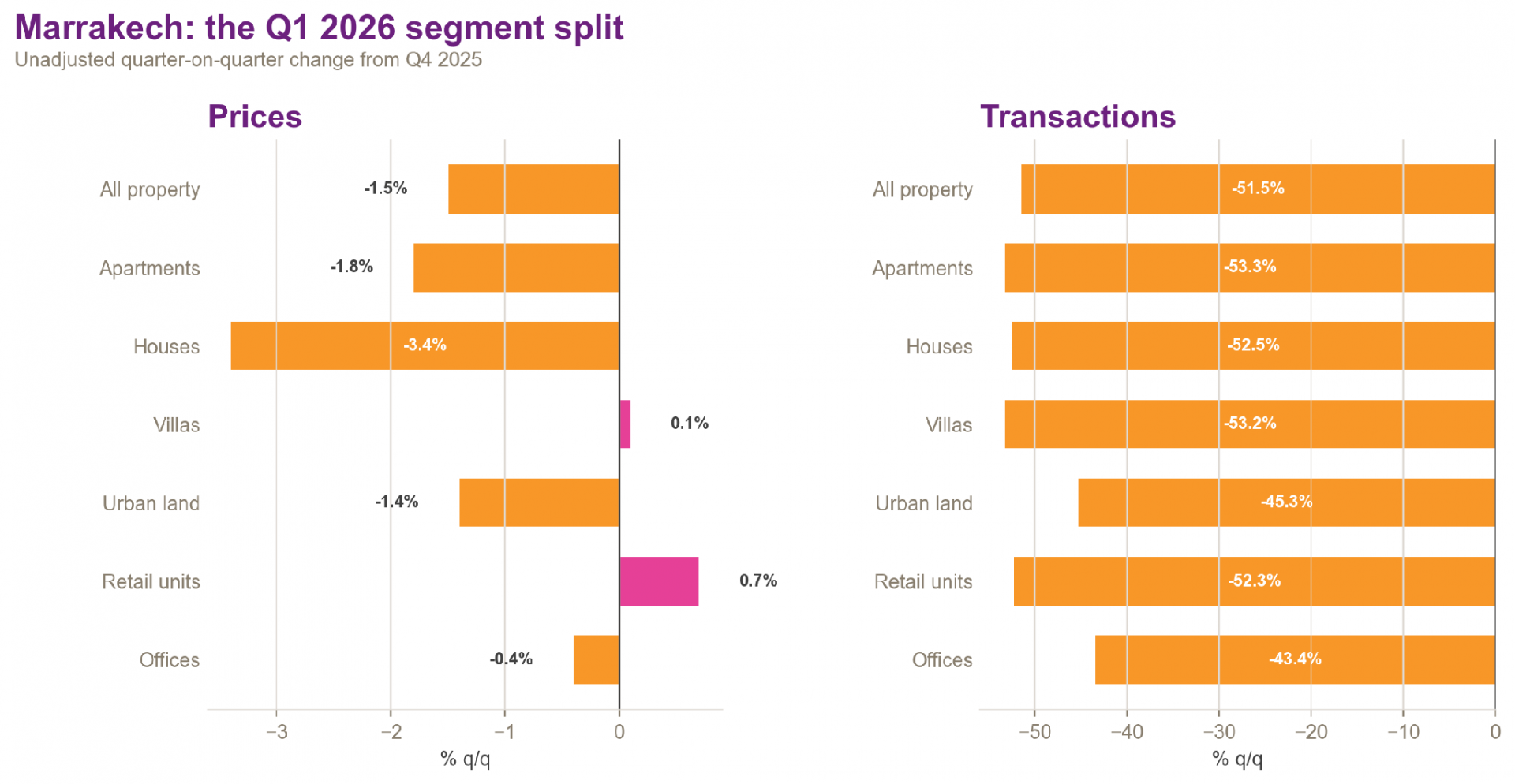
Apartments fell 1.8% quarter-on-quarter but rose 1.1% year-on-year. Houses fell 3.4% in the quarter and 0.3% over the year. Villas were essentially flat in Q1 (+0.1%) and 2.1% above Q1 2025. Each residential type nevertheless recorded a transaction decline of roughly 52%-53%.
Prices held better than turnover
Figure 1. Marrakech Q1 2026 price and transaction changes
Source: Bank Al-Maghrib / ANCFCC Q1 2026; Chestertons Morocco Research, analysis by Jawad El Hassani Sbai.
Professional assets were the relative winner
Professional prices rose 1.3% even as transactions fell 49.7%. Retail units increased 0.7%, while offices slipped 0.4%. The price resilience is notable, but the weak transaction denominator means the signal should be treated as selective rather than broad-based.
The strongest annual readings sit in villas and land
Villas (+2.1% y/y) and urban land (+1.6% y/y) outperformed the all-property index. This supports a relative-resilience thesis, not an acceleration thesis: both categories remain below earlier cycle peaks, and the quarter's transaction fall shows that market depth weakened sharply.
Marrakech in long-run context
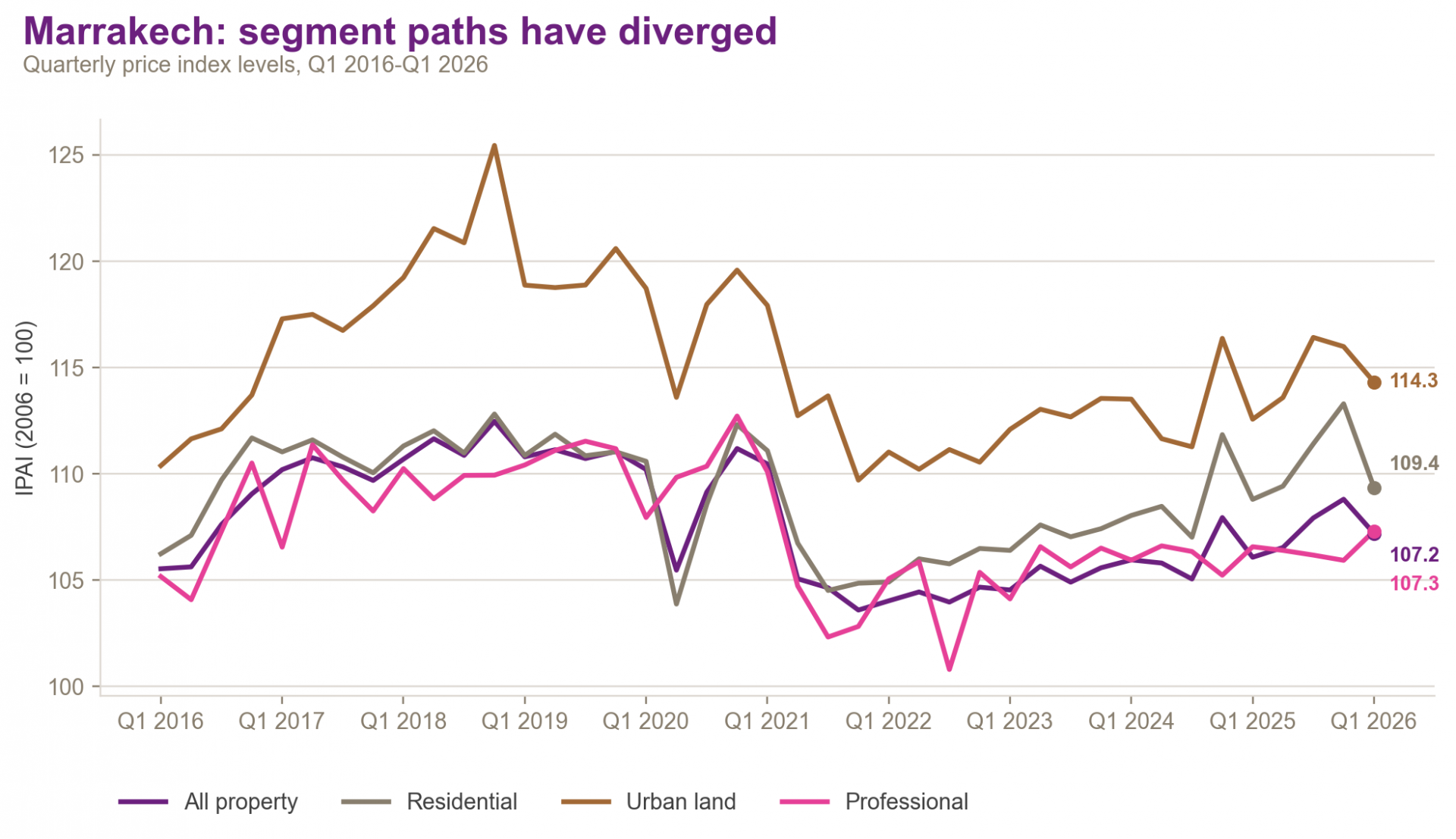
Figure 2. Marrakech price index levels since 2016
Source: detailed Bank Al-Maghrib / ANCFCC workbook; calculations by Jawad El Hassani Sbai for Chestertons Morocco Research. Base 100 = 2006.
The all-property index stands at 107.2, up 7.2% from 2006, 1.6% from Q1 2016 and 2.5% from Q1 2023. It is 3.0% below Q1 2021 and 10.3% below its Q4 2007 historical peak. The city's overall quarterly price volatility since 2006 is higher than the national index, so turning points require more than one observation.
The ten-year chart shows a gradual recovery from the 2021-2022 trough, led at different times by residential and land. The Q1 2026 decline interrupts that recovery but does not erase the positive year-on-year reading.
Tourism, investment demand and what the IPAI can prove
A genuine tourism tailwind
The Observatoire du Tourisme reported national arrivals up 7% in January-May 2026 and nights in classified accommodation up 9% in January-April, with foreign-currency receipts up 21%. This is supportive context for Marrakech's hospitality-linked economy, but the horizon extends beyond Q1 and the data do not establish a direct causal effect on property prices.
Financing remained available at the national level
Outstanding housing credit rose 2.9% year-on-year at end-March, while participatory housing finance continued to grow rapidly. These figures help explain why price support can coexist with weak turnover, but there is no city-level credit breakdown in the cited sources.
Media narrative versus primary data
Moroccan media broadly described Marrakech as a market with a sharp buyer pause and resistant prices. That framing matches the primary data. One repeated error deserves correction: -53.3% is the residential transaction change, while the city's global transaction change is -51.5%. The primary bulletin and workbook control throughout this report.
MY CORE TAKEAWAY Tourism and investor interest may support selected Marrakech submarkets, but the Q1 registry data show that price resilience was achieved with dramatically fewer transactions. Liquidity, not the headline price index, is the principal risk signal.
Chestertons Morocco field intelligence
WHAT OUR DAILY WORK ADDS Our pipeline and client conversations point to a market preparing for its next cycle. The opportunity is not uniform: new-build volume, planning constraints and international premium demand are creating distinct trajectories across mainstream residential, branded residences, ultra-prime villas and riads.
A substantial off-plan residential pipeline
Off-plan villa and apartment supply is building across three principal corridors: Gueliz-Agdal, Route d'Amizmiz and Route de l'Ourika. This visible pipeline creates near-term competition between schemes, particularly where specifications and delivery propositions are similar. It should also generate higher reservation, completion and transaction figures in coming quarters as projects progress. Because the IPAI is a repeat-sales index, the operating momentum in first-sale new development may become visible in official data only gradually.
The masterplan pause creates a future supply gap
The hold affecting the city's urban masterplan is interrupting momentum for new schemes and small-scale urban developments. In the short term, buyers can choose from the existing off-plan pipeline; beyond it, fewer fresh approvals may create a gap in delivery. This sequencing matters: current supply can weigh on absorption before a later planning bottleneck restores scarcity and supports well-located completed stock.
Premium demand is broadening
We are seeing rising enquiry and an expanding project pipeline for branded residences aimed primarily at international buyers. Demand for ultra-high-end property is also strengthening, especially where privacy, hospitality-level service, architecture and management quality are credible. These segments are small relative to the whole city, but they can support land values, product standards and Marrakech's international positioning.
Diaspora demand paused without forcing prices lower
Moroccan diaspora demand has slowed amid international economic uncertainty and geopolitical conditions. So far, our field experience suggests that the slowdown has reduced urgency more than pricing: owners and developers have generally resisted broad discounts. A stabilisation in external conditions would therefore release deferred demand into a market where prime sellers have retained their expectations.
The riad cycle is returning
Interest in riads is rising again, supported by renewed international exposure through creators and influencers, the growth of digital nomadism and expectations surrounding Morocco's 2030 World Cup cycle. The strongest demand is selective: authentic architecture, legal clarity, access, renovation quality and a viable hospitality or private-use proposition remain decisive. This is a positive niche trend rather than a blanket uplift for all medina stock.
MY FIELD CONCLUSION Marrakech is moving from a price-resilience story towards a segmented growth story. Existing off-plan supply can lift future volumes, while planning scarcity, branded residences, ultra-prime demand and the renewed riad market support a constructive medium-term outlook.
My Q2-Q4 2026 outlook
Base case: broader activity with selective price resilience
I expect transactions to rebound progressively as the off-plan pipeline in Gueliz-Agdal, Route d'Amizmiz and Route de l'Ourika converts into reservations and completions. Pricing should prove most resilient in branded residences, ultra-prime villas, strong land-backed schemes and investment-grade riads. Mainstream projects face greater competition; reputation, delivery certainty and specification will decide absorption.
Upside signals
Improving annual transaction growth, off-plan conversion without heavy incentives, more branded-residence launches and sustained ultra-prime and international enquiry would confirm the upside case. Renewed diaspora activity and tourism momentum would deepen the recovery.
Downside signals
Risks are delivery delays, repetitive off-plan product, a prolonged planning standstill and weaker diaspora purchasing power. Material incentives alongside negative villa or land price growth would weaken the current resilience case.
Methodology and sources
Marrakech indices use the Bank Al-Maghrib / ANCFCC repeat-sales methodology, base 100 in 2006. Only properties with at least two observed transactions enter the index; minimum transaction thresholds apply. Data are cut 35 days after quarter-end and can be revised. The IPAI does not measure asking prices, rents, new-build inventory or total investment returns. Field intelligence reflects qualitative observations from Chestertons Morocco's day-to-day mandates, negotiations and client interactions; it is directional, not a statistically representative survey. The interpretation, calculations and forward-looking judgements are my proprietary analysis for Chestertons Morocco.
CHESTERTONS MOROCCO RESEARCHMorocco property marketNational trend report | Q1 2026[[media code="q7vmbrw71f"]]Cover: Rabat by Steven C. Price (CC BY-SA 4.0) and Marrakech by Federico Mata (CC BY 3.0); cropped and colour-graded.Data through Q1 2026 | Published August 2026PROPRIETARY MARKET ANALYSISJawad El Hassani SbaiCEO, Chestertons MoroccoSigned for publication | August 2026Gl...
Affiliés de la marque Chestertons
Nous sommes fiers de célébrer une étape historique – cette année, Chestertons fête ses 220 ans d’excellence dans l’immobilier.Cet anniversaire marque non seulement plus de deux siècles de confiance, d’intégrité et d’expertise, mais aussi 20 ans depuis l...
CHESTERTONS MOROCCO RESEARCHRabat property market A constrained, segmented market with resilient premium pockets | Q1 2026 [[media code="wtvj4tskig"]]Cover: View of Rabat from Hassan Tower plaza by Steven C. Price, CC BY-SA 4.0; cropped and colour-graded.Data through Q1 2026 | Published August 2026PROPRIETARY MARKET ANALYSISJawad El Hassani SbaiCEO, Chestertons MoroccoSign...